

By Dr. Michael Berend, Board-Certified Orthopedic Surgeon, National Total Joint Replacement Thought Leader
Every week we hear the question “How long do knee replacements last?” At Midwest Center for Joint Replacement, our goal is to help you get back to the life you love and keep you there long term. We think a more important question to consider is, “What is the likelihood I will need another operation in my lifetime after a knee replacement?”
The good news is that modern knee replacements are designed to provide decades of pain relief and improved mobility. Recent research from around the US and our MCJR research contributions have shown that the implant is no longer the “weak link” leading to revision.
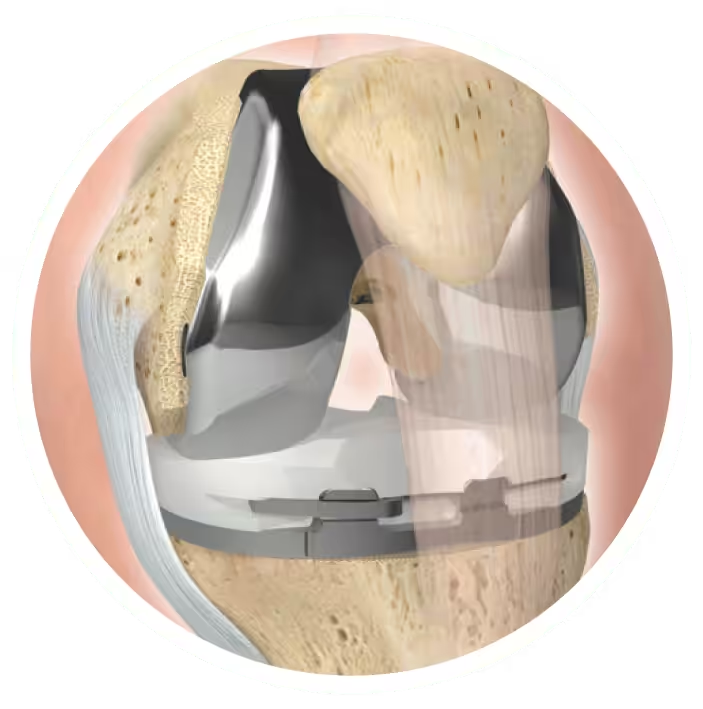
The Average Lifespan of a Knee Replacement
Most modern total knee replacements have a low likelihood of re-operation for 20 years or longer. In fact, studies show that approximately 90–95% of implants are still functioning well at 15 years, and many patients enjoy even longer-lasting results, particularly with advancements in surgical techniques, materials, and personalized care. The likelihood of needing another operation in your lifetime after a knee replacement is 10-15%.
The leading reasons for re-operation are:
- Infection
- Instability
- Kneecap problems
- Stiffness
- Fracture of the bones around the implant.
Implants wearing out is much further down the list.
Factors that Affect the Lifespan of an Implant
Several key factors influence how long your knee replacement will serve you well:
- Surgical Technique: Precision in alignment, soft tissue balance, and implant placement matters. At MCJR, we use advanced techniques – including minimally invasive approaches and patient-specific techniques – to optimize every surgery.
- Activity Level: Staying active helps keep your muscles and bones strong, and help preserve high function of the implant.
- Weight: Excess body weight adds extra stress to the joint. Maintaining a healthy weight reduces this load and extends implant lifespan.
- Implant Type: The materials and design of the implant play a significant role. At MCJR, we use state-of-the-art implants tailored to each patient’s anatomy and activity goals.
Knee replacement surgery is one of the most successful procedures in modern medicine. With the right care and attention, your implant can offer decades of pain relief, high function, and improved mobility.
At Midwest Center for Joint Replacement, we’re with you every step of the way—from your first consultation to lifelong joint health. If you have questions about your existing implant or are considering knee replacement, we’re here to help.
Contact us today to schedule a consultation or follow-up visit.

Michael Berend, MD specializes in total knee replacement and partial knee replacement surgery. Dr. Berend has been recognized as one of the top 22 knee replacement surgeons in the United States. He co-founded Midwest Center for Joint Replacement (MCJR) in 2015.